Rahu and Ketu in Vedic Astrology
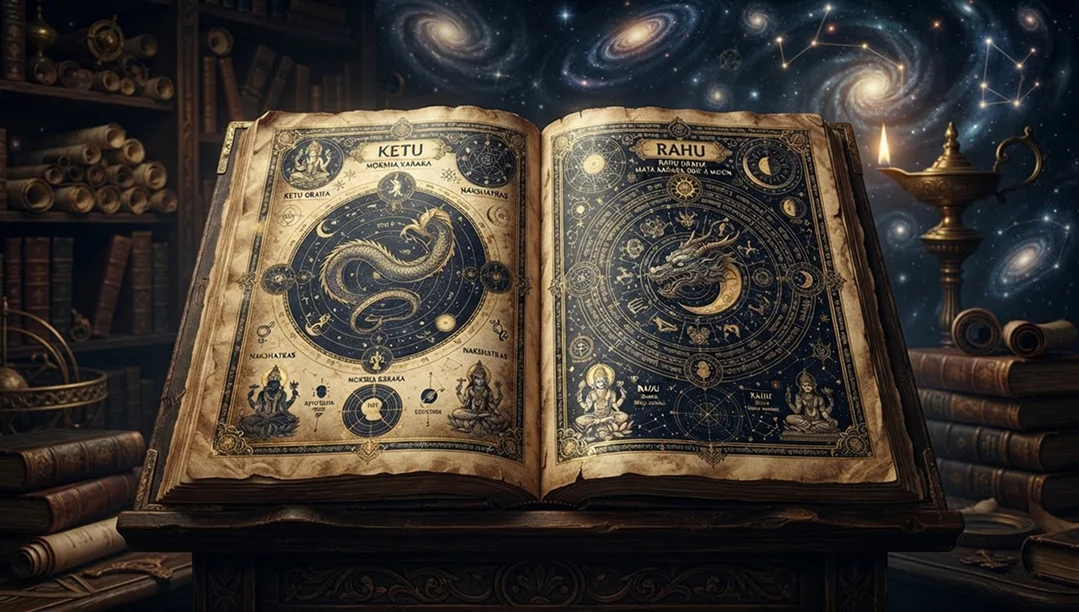
The Mysteries of Rahu and Ketu
Within the profound tradition of Vedic astrology, Rahu and Ketu are understood as powerful shadow planets. They are the lunar nodes: celestial points that mark the intersection of the Moon's orbit with the path of the Sun.
Rahu is linked with ambition, worldly desires, sudden change and unfamiliar experiences. Ketu is associated with detachment, inner wisdom and the lessons carried forward from the past.
Together, they form a karmic axis. Their placement in a birth chart can offer insight into the experiences a person is drawn toward and the patterns they are learning to release.
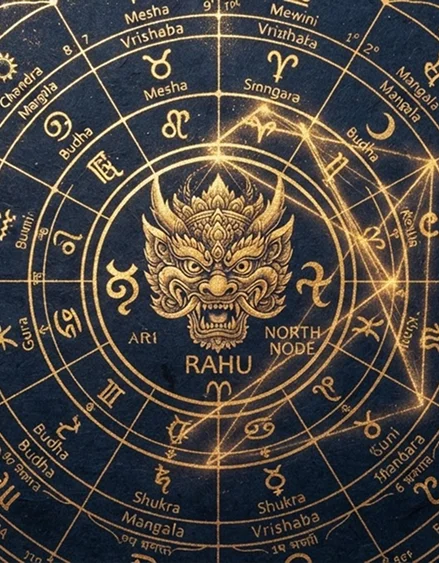
What Is Rahu in Vedic Astrology?
Rahu represents the ascending or north lunar node.
Within traditional Jyotish interpretation, Rahu is associated with ambition, desire, fascination, unconventional experiences, worldly attachments and the pursuit of material achievement.
Its placement in a birth chart is traditionally examined to explore areas where an individual may experience intense aspirations, unfamiliar circumstances or recurring patterns of attachment.
Traditional Significance of Rahu
- Material ambitions and professional aspirations
- Desire for recognition, influence and achievement
- Foreign connections and unconventional opportunities
- Fascination with technology, innovation and unfamiliar experiences
- Attachment, illusion and personal transformation
- Karmic themes associated with worldly experiences
Rahu is not inherently considered negative in every horoscope. Its interpretation depends upon the sign, house placement, planetary associations, aspects, dispositor and broader birth chart.
Guruji's Perspective: Rahu should never be interpreted in isolation. A meaningful astrological assessment requires careful consideration of the complete horoscope and the traditional principles of Jyotish.
What Is Ketu in Vedic Astrology?
Ketu represents the descending or south lunar node.
In Vedic astrology, Ketu is traditionally associated with detachment, introspection, spiritual discipline, liberation, renunciation and the search for deeper understanding.
Where Rahu is frequently connected with worldly pursuit, Ketu is often interpreted as representing withdrawal from attachments and the exploration of inner awareness.
Traditional Significance of Ketu
- Spiritual development and self-inquiry
- Detachment from material attachments
- Introspection and contemplative practices
- Traditional associations with past-life karma
- Liberation, or Moksha
- Inner transformation and philosophical understanding
Ketu's interpretation varies considerably depending on its position and relationship with other planetary factors.
It is therefore important to avoid simplistic assumptions that Ketu always indicates loss, suffering or spiritual advancement.
Rahu and Ketu: The Karmic Axis in Your Birth Chart (Kundli)
One of the most significant features of Rahu and Ketu is that they always occupy opposite positions in the zodiac.
Together, they form the Rahu Ketu axis, traditionally interpreted as a symbolic relationship between worldly desires and spiritual detachment.
In karmic astrology, this axis is often examined to understand contrasting areas of personal experience.
Rahu may symbolize the direction of intense worldly interests, while Ketu may represent areas associated with familiarity, withdrawal or spiritual reflection.
However, the interpretation of this axis is influenced by the entire natal horoscope.
The relationship between Rahu and Ketu should therefore be understood as part of a larger astrological framework rather than as a fixed prediction of destiny.
Rahu Ketu Effects in Different Houses
In Vedic astrology, the twelve houses represent different areas of life. Rahu and Ketu are interpreted according to the houses they occupy in the kundli and the broader planetary context.
| House | Traditional Area of Interpretation |
|---|---|
| First House | Identity, personality and self-development |
| Second House | Family, speech, values and resources |
| Third House | Communication, courage and personal initiative |
| Fourth House | Home, emotional foundations and domestic life |
| Fifth House | Education, creativity and children |
| Sixth House | Service, competition and daily challenges |
| Seventh House | Marriage, partnerships and relationships |
| Eighth House | Transformation, hidden matters and research |
| Ninth House | Philosophy, higher learning and spiritual beliefs |
| Tenth House | Career, public responsibilities and reputation |
| Eleventh House | Aspirations, social networks and gains |
| Twelfth House | Solitude, expenditure, retreat and liberation |
These house meanings provide only an introductory framework. A personalized interpretation requires assessment of planetary strengths, sign placements, house rulers, aspects and other relevant Jyotish principles. For a house-by-house guide, read Rahu in All 12 Houses.
Rahu and Ketu in Meditation and Inner Growth
Meditation and spiritual growth are another important area of Rahu Ketu interpretation.
In traditional Vedic astrology, the lunar nodes may be examined alongside the ninth house, Jupiter and other relevant chart factors to explore symbolic patterns relating to spiritual practice, intuition, inner awareness and meditative depth.
Rahu, for example Rahu in the 9th house, may be interpreted in connection with intense spiritual curiosity or unconventional meditative experiences.
Ketu may be associated with introspection, stillness or the desire for deeper awareness.
These interpretations should not be treated as guarantees of spiritual awakening, enlightenment or meditative outcomes.
Rahu Mahadasha and Ketu Mahadasha (with Antardasha)
The Vimshottari Dasha system is an important timing framework in traditional Vedic astrology.
Rahu Mahadasha: 18 years Ketu Mahadasha: 7 years
Astrologers traditionally examine these planetary periods, along with Rahu Antardasha and Ketu Antardasha sub-periods, in conjunction with the natal chart to interpret changing themes and circumstances.
The results attributed to any Mahadasha or Antardasha depend on numerous factors, including planetary placement, associations, house rulership and the wider horoscope.
A planetary period should not automatically be classified as fortunate or unfortunate without an individual assessment.
Traditional Rahu Ketu Remedies in Vedic Astrology
Traditional Jyotish practices include various spiritual observances associated with Rahu and Ketu.
Depending on individual beliefs, family traditions and astrological interpretation, these may include:
Mantra Recitation
Traditional prayers or Rahu Ketu mantras associated with the lunar nodes.
Meditation and Self-Reflection
Contemplative practices intended to encourage inner awareness.
Charitable Activities
Acts of service and generosity within an individual's spiritual tradition.
Spiritual Discipline
Personal observances inspired by established Vedic practices.
Individualized Traditional Guidance
Recommendations considered in the context of the complete natal chart.
These practices belong to religious and spiritual traditions. Their effectiveness in changing planetary influences or guaranteeing life outcomes has not been scientifically established.
Guruji emphasizes individualized interpretation rather than universal remedies presented as suitable for everyone.
Why Personalized Rahu Ketu Analysis Matters
No two natal horoscopes are identical.
Although general astrological descriptions may offer an introduction to Rahu and Ketu, they cannot account for every planetary relationship within an individual's chart.
A detailed traditional assessment may consider:
- Rahu and Ketu's zodiac signs and house placements
- Their nakshatras and planetary dispositions
- Relevant conjunctions and aspects
- The condition of important house rulers
- Planetary periods and subperiods
- The overall structure of the natal horoscope
With 47 years of professional experience, Guruji approaches Rahu-Ketu interpretation through careful consideration of the complete horoscope and established Jyotish principles.
Explore Your Karmic Blueprint with Guruji
For those seeking a more personalized exploration of Rahu and Ketu within traditional Vedic astrology, Guruji offers:
Personalized Rahu Ketu natal chart assessment
90-minute confidential online video consultation
Traditional Vedic spiritual recommendations
One written clarification within 23 days
Private Consultation Investment: ₹140,000
An Exclusive Private Astrological Consultation with Guruji
Frequently Asked Questions
Is Rahu always a malefic planet?
Rahu is traditionally considered a shadow planet, but its results are not interpreted as uniformly good or bad. Its house, sign, associations, aspects and planetary period all matter.
Is Ketu a spiritual planet?
Ketu is traditionally associated with detachment, introspection and spiritual inquiry. Its meaning in an individual chart depends on the wider horoscope.
Can Rahu and Ketu affect relationships?
Astrologers may consider the nodes' relationship to partnership houses and their planetary associations when discussing relationships. A complete chart is needed for context.
What is Rahu Ketu transit?
A transit describes the apparent movement of the lunar nodes through zodiac signs over time. Traditional readings consider a transit alongside the person's birth chart and current Dasha.
Which remedies are recommended for Rahu and Ketu?
Traditional recommendations vary by person and tradition. Meditation, prayer and charitable acts are among the practices some people choose; consult a trusted practitioner for personal guidance.
Why should Rahu and Ketu be read together?
The nodes always form an axis in a birth chart, occupying opposite points. Considering both placements gives a more complete view than focusing on only one node.